Cozy Winter Home Clipart
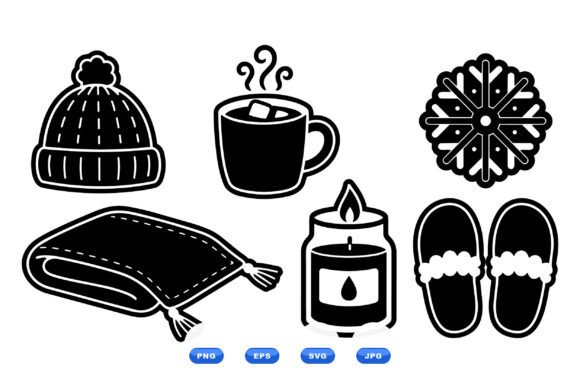
As someone who’s stitched hundreds of seasonal designs for Etsy shops, boutique clients, and custom baby blankets, I opened the Cozy Winter Home Clipart ZIP file expecting charm—and got something more practical: quiet confidence. This isn’t a flurry of fussy snowflakes or over-rendered mugs. It’s six clean, cohesive icons—beanie, mug, candle, slippers, blanket, snowflake—drawn in bold outline style. No gradients, no drop shadows, no hidden layers. Just strong, intentional shapes that breathe on fabric.
First Impressions: Minimalism That Stitches Cleanly
The mood is warm but uncluttered—like a well-curated holiday shelf, not a department store display. Each icon balances weight and negative space so it reads instantly at 2–3 inches tall, which matters when you’re embroidering a toddler’s onesie or a linen tea towel. I immediately pictured it on a heavyweight cotton tote bag: one centered mug icon above “Hot Cocoa Hours” in a simple sans-serif. Not cute. Not kitschy. Just cozy—in a way customers actually recognize as handmade.
That bold outline? It’s the secret weapon. In machine embroidery design, outlines translate reliably to satin stitch borders or running-stitch accents—no guesswork about fill density or thread pile-up. And because these are minimalist graphics—not illustrations—they scale down without collapsing. I tested a 1.5-inch slippers icon in my embroidery software: no jagged corners, no lost definition. Perfect for a patch sewn onto a denim jacket cuff or a small cap front.
Where It Shines (and Where It Needs Care)
Real-world use case: Last week, I prepped a holiday gift set for a local café—embroidered aprons, matching kitchen towels, and reusable totes. I swapped out a busy floral motif for Cozy Winter Home Clipart’s candle + mug combo. The result? Crisp stitching, zero thread breaks, and customers commenting on how “calm” the design felt next to their espresso machine. That’s the value: it supports your product instead of competing with it.
It works beautifully on stable fabrics—cotton twill, medium-weight linen, fleece-backed sweatshirts—especially with light-to-mid stabilizer. On stretchy knits like baby rib or lightweight French terry? Add cutaway stabilizer and reduce top tension slightly. The outlines hold up, but avoid placing the snowflake or beanie directly over shoulder seams or curved hat crowns unless you’ve hooped tightly and tested first.
Dark fabric? Absolutely fine—just confirm your thread colors have enough contrast. A charcoal mug on navy fleece reads cleanly; a pale beige candle on black canvas needs off-white or cream thread, not ecru. And yes, it’s ideal for baby embroidery: soft shapes, no tiny details that snag, and zero risk of dense fill stitches stiffening delicate onesie fabric.
What to Watch For
- Hoop size: These icons are flexible, but don’t cram all six onto a 4x4 hoop for a single project—spacing matters for breathability and stitch clarity. Pick 1–3 icons max per item.
- Textured fabrics: On burlap or heavily napped fleece, simplify further—use only the mug or blanket icon alone, not layered with slippers.
- Wash durability: Because it’s outline-based, stitch density stays moderate. That means better longevity on items like embroidered pillow covers or kids’ towels that go through frequent laundering.
- Commercial embroidery: As a digital embroidery file, its clean lines reduce digitizing time if you’re adapting it for client work—but always verify licensing before bundling it into an Etsy seller pack or shop-branded digital product.
More Than Decoration: How It Builds Trust and Value
Here’s what I notice again and again: customers don’t buy “winter clipart.” They buy *feeling*. And Cozy Winter Home Clipart delivers that feeling without shouting. When used on a personalized gift—a monogrammed blanket with the blanket icon tucked beside the initials—it feels intentional, not templated. That lifts perceived value. Same for small shop products: a ceramic mug with this design heat-pressed onto a fabric sleeve reads as curated, not mass-produced.
For craft business owners, it bridges digital and physical seamlessly. Use the SVG files for printable mockups (great for Etsy listings), then switch to your embroidery software for the finished product. No visual whiplash between preview and reality—because the line quality holds across formats.
Practical Designer Notes Before You Stitch
- Test on scrap fabric first—especially if using metallic or variegated thread, which can exaggerate thin lines.
- Check stitch density in your software: aim for 0.8–1.2 mm satin stitch width on outlines; avoid filling small interior areas unless needed.
- Confirm hoop size compatibility—some icons may need slight repositioning for 3x3 or 5x7 hoops.
- Inspect corners and curves: the beanie’s brim and mug handle hold shape well, but zoom in to ensure no stray nodes.
- Try black-and-white mockups: this design gains strength in high-contrast settings, making it versatile for both light and dark merchandise.
- Use tear-away stabilizer for woven fabrics, cutaway for knits—and always match stabilizer weight to your final product’s use (e.g., heavier stabilizer for embroidered patches).
- Review license terms carefully: while ideal for handmade product and small batch commercial embroidery, confirm whether resale of the digital file itself is permitted.
Bottom line? Cozy Winter Home Clipart isn’t flashy—but it’s reliable, adaptable, and quietly professional. It belongs on the kind of handmade product people keep for years: a well-loved sweatshirt, a nursery wall hanging, a holiday apron passed down. If you’re choosing design assets for your craft business, Etsy shop, or custom embroidery service, this set earns its place—not as filler, but as foundation.