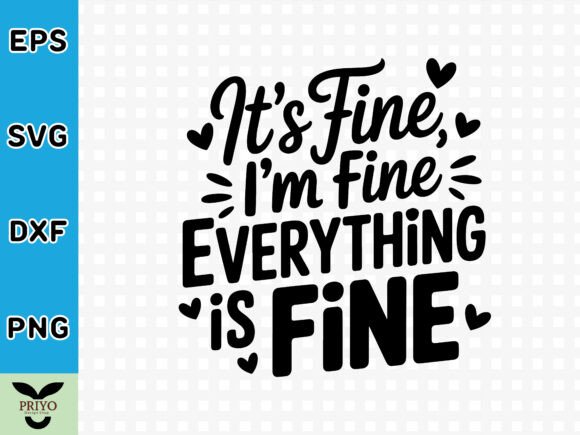
It’s Fine, I’m Fine, Everything Is Fine
As a designer who’s stitched thousands of phrases onto tote bags, baby onesies, and boutique aprons—and reviewed hundreds of embroidery files for craft businesses—I approached It’s Fine, I’m Fine, Everything Is Fine with equal parts curiosity and caution. It’s the kind of phrase that lands softly at first glance but carries quiet weight in real life—especially when stitched by hand or machine onto something meant to be held, worn, or gifted. So I didn’t just open the SVG and call it done. I tested it—not on screen, but on fabric.
A Design That Breathes With Intention
The first thing that stands out about It’s Fine, I’m Fine, Everything Is Fine is its gentle rhythm. It’s not shouting. It’s not sarcastic in tone—unless you choose to stitch it that way with sharp angles and tight kerning (and honestly, you could). As delivered, it leans into soft curves, modest letter height, and balanced spacing. That makes it unusually versatile: equally at home on a linen tea towel for a calm kitchen corner or a cotton sweatshirt for someone navigating a tender season.
I used it for a custom embroidered canvas tote bag—intended as a small-batch gift for a local therapist’s waiting room. The phrase landed right: warm, grounded, quietly affirming. Not clinical. Not flippant. Just human. That’s rare in craft design, especially in the Crafts category where whimsy often overshadows authenticity.
Where It Stitches Best—And Where It Needs Care
It’s Fine, I’m Fine, Everything Is Fine shines in mid-to-large hoop applications: 4x4 inches and up. On a standard tote bag panel? Excellent. Sweatshirt chest placement? Clean and legible. Pillow cover center? Calming and centered. Baby onesie back embroidery? Works—if you scale thoughtfully and avoid dense fill stitches near seams.
But here’s what I watched closely:
- Small hoop sizes (under 3x3): The lowercase “i” dots and subtle curves compress quickly. At tiny scales, the phrase risks looking cramped—not charming, just unclear.
- Textured or stretchy fabrics: On slubbed linen or lightweight knits, I added medium-weight cutaway stabilizer beneath and a light tear-away on top. Without it, the satin stitch edges softened too much, blurring the phrase’s gentle precision.
- Dark or heavily dyed fabrics: The design doesn’t include built-in drop shadows or outlines—so thread contrast matters. I tested navy thread on cream cotton and white thread on charcoal terry cloth. Both worked, but only after checking mockups in grayscale first.
- Curved surfaces like caps or curved mugs: Not ideal straight-out-of-the-file. The linearity of the phrase resists gentle contouring. If using on a cap, plan for slight manual reshaping—or pair it with a simple border element to anchor the curve.
What It Adds to Your Finished Product
This isn’t just text—it’s emotional texture. When stitched cleanly, It’s Fine, I’m Fine, Everything Is Fine elevates a handmade product from “nice” to “meaningful.” Customers notice. Etsy sellers tell me buyers comment on how “seen” the phrase makes them feel—even on a kitchen towel.
For small shop owners and Etsy sellers, that resonance translates directly to trust and repeat engagement. It reads as intentional, not trendy. And because it avoids slang, irony overload, or dated references, it holds up across seasons—making it solid design assets for holiday embroidery, nursery decor, or wedding weekend gifts (think: embroidered napkins for the “calm before the chaos” moment).
That said, it won’t punch through visual noise. It’s not a bold logo replacement or a high-contrast storefront banner. It’s a whisper—not a megaphone. Use it where quiet confidence fits the brand: wellness studios, slow-living boutiques, mindfulness-focused apparel lines, or personal keepsakes.
Practical Designer Notes Before You Stitch
Before committing to your next batch of custom apparel or personalized gifts, here’s what I do—and recommend:
- Test on scrap fabric first, especially if using textured weaves or blends. Watch how the fill stitch settles into gaps.
- Check thread color contrast in natural light—not just under your studio lamp. What reads clearly at noon may fade at dusk.
- Review stitch density. If your machine flags tension issues, simplify small interior curves manually—or reduce density slightly in the “e” counters and “a” bowls.
- Confirm hoop size compatibility. This isn’t a one-size-fits-all embroidery file. Know your smallest viable layout before digitizing or resizing.
- Inspect small details at 200% zoom: dot alignment on “i”, spacing before apostrophes, and baseline consistency. Tiny shifts change readability.
- Test black-and-white mockups—no color distraction—to assess balance and hierarchy.
- Compare light vs. dark fabric backgrounds using actual swatches, not just digital previews.
- Use proper stabilizer. For applique design-adjacent uses (like layered patches), fuse a lightweight fusible first—then embroider over it.
- Verify licensing. Since this is listed as a Graphics item and marketed for prints, mugs, and posters, confirm whether commercial use of the finished product (e.g., selling embroidered totes) is permitted—and whether resale of the digital embroidery file itself is allowed.
Final Thought: A Phrase That Earns Its Place
It’s Fine, I’m Fine, Everything Is Fine isn’t flashy—but then, neither is most real-life resilience. As an embroidery project, it rewards thoughtful execution. It asks for attention to fabric choice, stabilizer, and thread—not just speed or scale. And that’s exactly why it works so well for craft businesses building trust, not just traffic.
Whether you’re stitching it onto a baby blanket for a friend’s newborn, branding a line of mindful kitchen goods, or creating a limited-run patch series for your small shop product line—it holds space. Quietly. Honestly. With care.