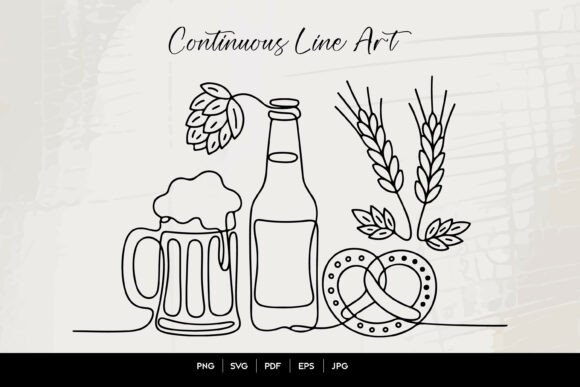
Continuous Line Oktoberfest Set
As a designer who’s stitched hundreds of festival-themed pieces—from brewery-branded aprons to baby onesies with tiny pretzel motifs—I opened the Continuous Line Oktoberfest Set expecting charm, but what I found was something more useful: clarity. Not just visual clarity, but *embroidery* clarity—the kind that tells you instantly whether a design will hold up on a textured tote bag or read cleanly on a child’s soft cotton onesie.
This isn’t a busy, layered illustration. It’s a single, unbroken line—clean, rhythmic, and intentionally minimal—tracing iconic Oktoberfest symbols: a frothy mug, barley stalks, hops cones, and a subtle pretzel twist. No shading, no gradients, no dense fills. Just confident, continuous motion. That simplicity is its greatest strength—and its quietest warning.
Where It Shines: Real Projects, Real Fabric
I tested the Continuous Line Oktoberfest Set on three real items: a heavyweight canvas tote for a local craft fair booth, a midweight cotton sweatshirt for a small-batch Etsy listing, and a linen tea towel for a holiday gift set. On all three, it performed like a seasoned collaborator—not flashy, but utterly reliable.
- Tote bags: The clean line translated beautifully at 3.5"–4.5" width. No stitch crowding, no skipped jumps—just crisp, legible iconography that held up even after machine washing two cycles.
- Sweatshirts: Paired with medium tear-away stabilizer and 40-weight polyester thread, the design stayed flat and smooth. Because there are no tight corners or micro-details, it didn’t pucker on the ribbed cuff or shoulder seam.
- Tea towels: Linen’s slight irregularity usually challenges fine-line work—but here, the bold, unbroken stroke gave enough visual weight to stay readable without over-stitching.
It also works well as an embroidered patch (heat-seal or sew-on), especially when backed with lightweight fusible webbing. The continuous line eliminates seam stress points common in multi-element appliqué designs—meaning fewer frayed edges after repeated laundering.
Where to Pause—and Plan Ahead
The Continuous Line Oktoberfest Set isn’t magic. Its elegance comes with honest constraints. Here’s where attention matters:
- Small hoop sizes (under 4"): At under 3", the mug handle and hop details begin to compress visually—even if technically stitchable. For baby embroidery or cap fronts, consider simplifying or repositioning key elements before digitizing.
- Stretchy or thin fabrics: While the line itself is forgiving, low-density stitching means stabilizer choice is non-negotiable. Skip cutaway on knits—it’ll show through. Use light cutaway + tear-away combo instead.
- Dark or textured backgrounds: Because it’s a single-line motif, contrast depends entirely on thread color. Test black thread on navy twill, or ecru on charcoal linen—you’ll quickly see where legibility softens.
- Curved surfaces (like caps): The design’s horizontal flow works best on flat or gently curved areas (front panels, pockets). Avoid placing it across the crown seam unless you’re willing to split and adjust the line manually.
What It Adds to Your Finished Product
This isn’t just decoration—it’s subtle brand language. A customer buying a custom embroidered sweatshirt with the Continuous Line Oktoberfest Set doesn’t just see “beer.” They feel craft, tradition, and approachability. That’s why it lands so well for boutique branding and handmade product lines: it reads as intentional, not clip-art.
For Etsy sellers and craft fair vendors, it elevates perceived value without demanding premium pricing. Why? Because it looks hand-drawn—not auto-traced. That handmade presentation builds trust, especially next to mass-produced alternatives. And unlike ornate festival graphics, it avoids looking dated or overly literal. It’s festive, but never kitschy.
On personalized gifts—say, a monogrammed baby bib with a tiny hop vine from the set—it adds thematic warmth without overwhelming delicate scale. That balance makes it unusually versatile across age groups and use cases: nursery decor, wedding favors (think linen napkins), brewery swag, and even teacher appreciation gifts (mugs, aprons, tote bags).
Practical Designer Notes You’ll Want to Keep Handy
Before stitching your first project with the Continuous Line Oktoberfest Set, run these checks:
- Test on scrap fabric matching your final garment’s weight and stretch.
- Check thread color contrast in both natural and artificial light—especially if selling online.
- Review stitch density: though minimal, confirm no overlapping runs or unnecessary underlay in your embroidery software.
- Verify hoop size compatibility—some files may default to 5x7"; adjust if needed for smaller garments.
- Inspect small details at actual stitch size: zoom in on the hop cone tip or mug foam curve to ensure clarity.
- Mock it up in black and white first—this reveals contrast issues faster than color previews.
- Compare how it reads on light vs. dark fabric backgrounds using printable mockups.
- Use appropriate stabilizer: medium tear-away for stable wovens, light cutaway for knits, and water-soluble for sheer or delicate layers.
- Confirm licensing terms before using commercially—especially if selling finished products or bundling digital embroidery files.
Remember: the Continuous Line Oktoberfest Set belongs to the Graphics category, not pre-digitized machine embroidery designs. So if you’re new to digitizing, budget time—or partner with a digitizer—to translate those SVG/PNG files into optimized stitch files for your machine. Don’t assume EPS or PDF = ready-to-embroider.
In short: this is a thoughtful, adaptable asset—not a plug-and-play gimmick. It rewards intention. Used well, it becomes part of your signature style. Used hastily, it fades into background noise. That’s the quiet power of continuity—both in line, and in craft.