Campfire in Pine Forest Night Silhouette
First Impressions: Moody, Minimal, and Surprisingly Versatile
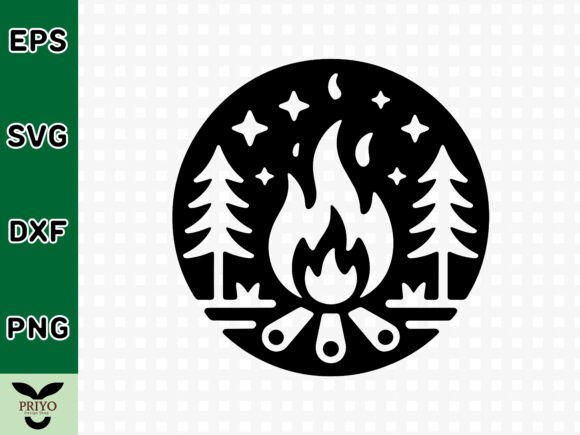
When I opened Campfire in Pine Forest Night Silhouette for the first time, I didn’t see just another nature-themed graphic—I saw a quiet moment frozen in thread. The composition is clean: tall pine silhouettes frame a central campfire glow, all rendered in bold negative space. There’s no clutter—no stars, no smoke wisps, no text—just confident shape language and intentional emptiness. That restraint is its biggest strength. As a designer who’s stitched hundreds of woodland motifs, I immediately recognized how well this would translate to embroidery: strong outlines, generous interior spacing, and zero fussy details that vanish under satin stitch or blur on textured fabric.
A Real-World Test: Embroidering It on a Linen Tote Bag
Last week, I used Campfire in Pine Forest Night Silhouette for a custom order—a heavy natural linen tote for a local outdoor gear shop. I chose black thread on oat-colored fabric, hooped with medium-weight cutaway stabilizer. The result? Crisp, grounded, and unmistakably handmade—not printed, not stamped, but *stitched*. Customers paused at the booth to touch the texture. That tactile authenticity matters. This isn’t a design that shouts; it invites leaning in. For craft businesses, Etsy sellers, or boutique owners building a cohesive seasonal collection (think “cozy autumn,” “cabin core,” or “quiet wilderness”), Campfire in Pine Forest Night Silhouette delivers instant mood without sacrificing clarity.
Where It Shines—and Where to Pause
Campfire in Pine Forest Night Silhouette performs beautifully on stable, medium-weight fabrics: canvas totes, cotton sweatshirts, tea towels, pillow covers, and structured caps. Its silhouette-based layout avoids fine linework, so it holds up even on slightly stretchy fleece or looped terry cloth—provided you use appropriate stabilizer. I’ve run it successfully as an embroidered patch (with border satin stitch), on baby onesies (scaled down to 3.5 inches wide), and as holiday gift embroidery on flannel blankets.
But here’s where practical judgment kicks in:
- Small hoop sizes: Below 4 inches wide, the fire’s glow loses definition. If you’re stitching on a child’s cap or tiny apron pocket, test the scaled version first—you may want to simplify the flame area manually.
- Dark or heavily textured fabric: On charcoal twill or thick bouclé, the negative-space fire won’t “pop” unless you add a subtle fill stitch or light-toned underlay. Don’t assume contrast—it must be verified.
- Frequent-wash items: Like kitchen towels or baby bibs, these need tight stitch density and secure jump stitches. Check the file’s fill stitch behavior—some versions layer too loosely for high-abrasion use.
- Curved surfaces: On baseball caps, the pine tops can distort if hooping isn’t precise. A gentle curve works; a steep dome doesn’t.
Design Integrity Meets Customer Trust
What makes Campfire in Pine Forest Night Silhouette more than just a pretty graphic is how it supports your credibility as a maker. When customers see this on a handmade product—say, a personalized nursery pillow or a small-shop sweatshirt—they read intention, not trend-chasing. The simplicity reads as confidence. That translates directly to perceived value: buyers pay more for pieces that feel considered, not copied. For Etsy sellers listing digital embroidery files, this design stands out because it’s distinctive *and* production-ready—not overly detailed, not underdeveloped, just right for real-world stitching.
Practical Designer Notes Before You Stitch
Before committing to a client project or bulk production, run these checks:
- Test on scrap fabric—same weight and weave as your final piece. Linen behaves differently than cotton poplin; don’t skip this step.
- Review stitch density. Is the fire area dense enough to avoid “see-through” on light fabric? Does the pine outline hold crispness at your chosen size?
- Confirm hoop size compatibility. If your machine maxes out at 4x4”, verify the design fits—or plan for re-hooping (not ideal for alignment).
- Inspect small details: Are corners sharp? Do any elements taper into vanishing points? Those often fray or mis-stitch.
- Mock it in black and white first—this reveals contrast issues faster than color previews.
- Try both light and dark fabric backgrounds in your design software. What reads as “glow” on white may disappear on navy.
- Use proper stabilizer: Cutaway for knits, tear-away for stable wovens, and fusible + cutaway for nap-heavy fabrics like fleece.
- Verify licensing. Since this is listed as a Graphics file in the Crafts category, confirm whether commercial use—especially resale of finished embroidered products or digital embroidery files—is permitted. When in doubt, contact the seller.
Final Thought: A Design That Works Quietly, But Well
Campfire in Pine Forest Night Silhouette won’t dazzle with complexity—but then, it’s not meant to. It’s a thoughtful, stitch-smart asset built for repetition, reliability, and resonance. Whether you’re a solo embroiderer filling holiday orders, a small shop owner curating cabin-chic merchandise, or an Etsy seller expanding your digital embroidery file catalog, this design earns its place by doing exactly what it promises: evoking stillness, warmth, and wildness—all in one clean silhouette. Just remember: even the quietest designs demand careful execution. Test, adjust, and trust your eye—not the preview thumbnail.